
Tishomingo County Arrest Records and Court Charges
An arrest record is the record of the arrest itself. It captures who was taken into custody, which agency made the arrest, and the booking that follows at the jail. In Tishomingo County most arrests run through the Sheriff's Office and Detention Center under Sheriff Jamie Stuart, though city police in Iuka, Belmont, and other towns also make arrests. The booking charge listed at intake is the officer's first read of the offense. It is not the final word. Once the arrest is done, a prosecutor reviews the facts and decides which formal charges to file with the court clerk. That filing is what turns a booking charge into a court charge record.
The two records live in different places. The arrest and booking side is held by the sheriff, so the jail roster and custody detail belong with the inmate side of the system. For the booking and custody view, the Tishomingo County inmate records page covers the roster, the detention center, and how to confirm someone is in custody. The court charges after arrest are what the prosecutor actually filed, and those get tracked through the case as it moves. The full case file, with pleas, hearings, and the final outcome, sits on the criminal court records page. This page stays on the bridge between the two: the arrest, the charges filed, and the status those charges carry.
How to Find Tishomingo County Arrest Records and Charges
There is no single county website that posts a mugshot list or a public arrest blotter for Tishomingo County. Records are split by office. The booking and custody side runs through the sheriff. The filed charges and their status show up in the court case record, which for felonies and many civil files is kept by the Circuit Clerk and is reachable online through the statewide Mississippi Electronic Courts system. Justice Court and the city courts hold the lower-level charges. Because of that split, the search you run depends on which half you need.
The Tishomingo County Sheriff's Office posts its contact lines and public-safety pages at its own site, which is the first stop for arrest and booking questions. You can reach the Tishomingo County Sheriff's Office online for phone numbers and detention information.
The sheriff's site does not run a name-by-name booking search on the web, so custody confirmation usually means a call to the detention center or a check of the MobilePatrol app. To read the charges a prosecutor filed, you work the court case record instead. These steps walk the court side from name to charge.
- Open the Mississippi Electronic Courts portal and choose the case search or document access tool for trial-court records.
- Search by the defendant's name, or by the case number if you already have it from the clerk.
- Open the matching case and read the charge list filed by the State.
- Check each charge for its statute code, its level, and its current status.
Online document viewing through Mississippi Electronic Courts, often shortened to MEC and its public side PAMEC, is login-gated and may carry a fee. The portal sits at courts.ms.gov/mec/mec.php, and a public account is set up through the registration page at pamecapps.mec.ms.gov/onlinereg. When the case is not online, the Circuit Clerk's office in Room 204 of the courthouse can pull the file at the counter.
Who Files Charges in Tishomingo County
The officer who makes an arrest does not get the last word on the charges. That power sits with prosecutors, and the county uses more than one. For felonies, the District Attorney for the First Circuit Court District decides whether to charge and what to charge. That office is led by District Attorney Jason D. Herring, who took the post in October 2024. The First Circuit covers seven counties, including Tishomingo, with main offices in Tupelo and Corinth. Serious cases route there for review and grand jury presentation.
Lower-level matters take a different path. The county's local prosecuting attorney, Nathaniel Clark, works with Justice Court on misdemeanors and similar charges. A regular person can also start a criminal complaint here. Under the process the Sheriff's Office describes for Justice Court, you visit the Justice Court offices in the courthouse and swear out an affidavit. There is no charge to file an affidavit. The clerk cannot supply the facts for you, so the sheriff recommends speaking with an officer or investigator first.
The affidavit has to carry specific information for a charge to move forward.
- Who is being charged.
- An address or description of where that person can be found.
- At least one legal identifier, and ideally two, such as a date of birth or Social Security number.
- What offense is being charged.
Note: If a complainant later wants to drop a sworn affidavit, a fee applies to dispose of it, so the Justice Court clerk should be asked for the current amount.
How Tishomingo County Charges Get Filed After an Arrest
The arrest and booking come first. The court charge record begins a step later, when a prosecutor files a charging document with the clerk. That document is what formally accuses a person and opens the case. Mississippi uses three main types, and the one used depends on how serious the offense is and which court hears it. The sheriff's detention and intake pages describe how a booking charge starts that chain.
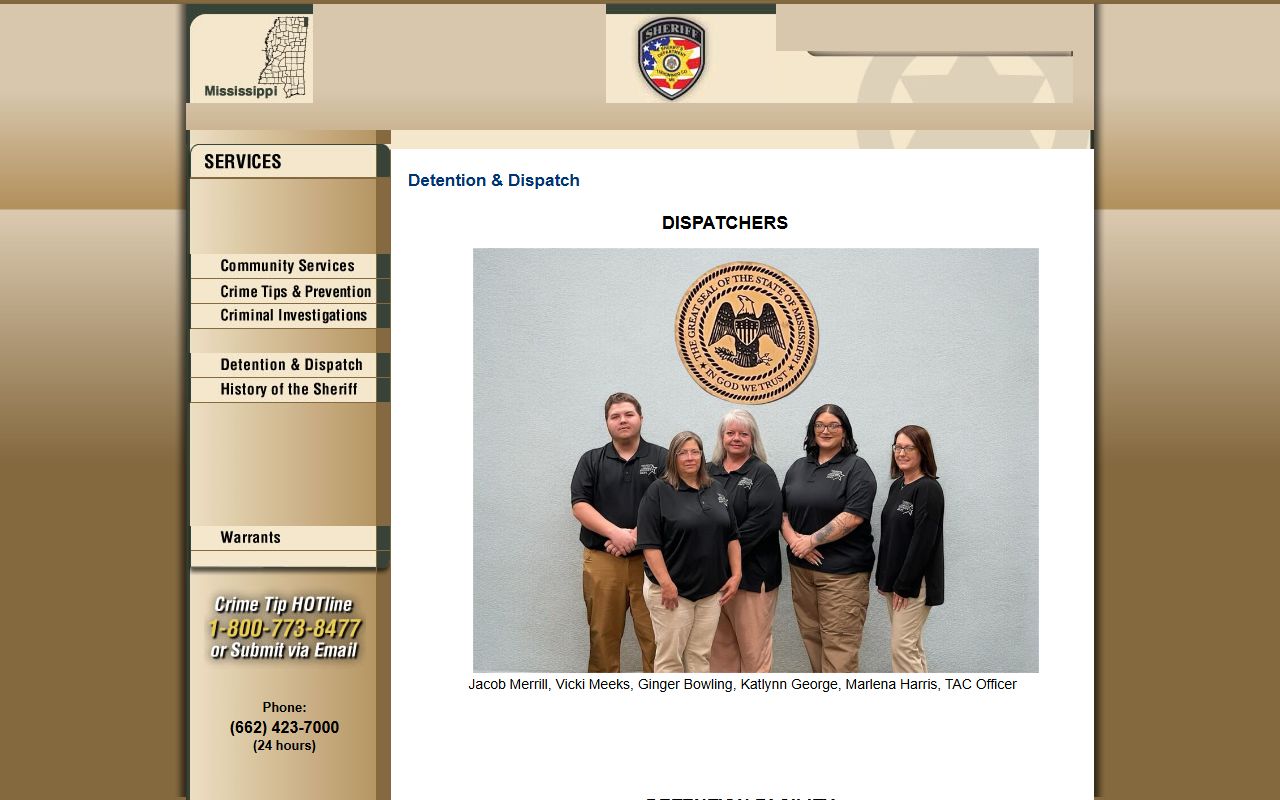
You can review the detention center information the Sheriff's Office publishes on its detention and booking page to see how custody and intake are handled before charges are filed.
Once intake is complete, the offense routes to the right court and the matching charging document. The table below sorts the three types by who files them and what they are used for.
| Complaint | Information | Indictment | |
|---|---|---|---|
| Filed By | Officer / Prosecutor | Prosecutor | Grand Jury |
| Common For | Misdemeanors | Many felonies | Serious felonies |
| Starts | The case | The case | The case |
In Tishomingo County, a misdemeanor complaint or affidavit usually starts a case in Justice Court or a city court. A felony is typically presented to a grand jury, and a true bill returns an indictment that the Circuit Clerk files in Circuit Court. The Circuit Clerk, Rebecca Oaks, receives indictments and other criminal papers and keeps the felony case file for the county.
Charge Status on a Tishomingo County Record
Charges do not stay frozen once they are filed. As a case moves, a charge can be amended, reduced, added, dropped, or dismissed. The booking charge from the arrest may never match the charge the prosecutor files, and the filed charge may shift again before the case ends. Reading the status correctly matters, because a dropped count and a pending count tell very different stories about the same person.
The Sheriff's Office keeps real-time detention information on its public pages, which can show whether a person is still held while charges are pending. You can see the kind of detention and public-information detail it offers on the Sheriff's Office detention information page.
The court record uses a set of common status terms. The table below defines the ones you are most likely to see on a Tishomingo County charge.
| Status | What It Means |
|---|---|
| Pending | The charge is filed and active, but no plea, verdict, or dismissal has resolved it yet. |
| Amended / Reduced | The charge was changed, often to a lower level, after the case was reviewed. |
| Dismissed | The court dropped the charge, so it ends without a conviction. |
| Nolle Prosequi | The prosecutor chose not to pursue the charge, ending it without a trial. |
Charges vs. Convictions
Being charged is not the same as being convicted. A charge is an accusation. It means a prosecutor believes there is enough cause to bring the count to court. A conviction is the outcome, entered only after a guilty plea or a verdict of guilt. Many charges never become convictions. They get reduced, dismissed, or dropped along the way. Treating a filed charge as proof of guilt is a common and costly mistake when reading an arrest or charge record.
| Charge | Conviction | |
|---|---|---|
| Stage | Accusation | Verdict or plea |
| Burden of Proof | Probable cause | Beyond reasonable doubt |
| Public Record | Yes | Yes |
Sealed vs. Expunged Records
Some charge records are pulled from public view. The two ways that happens, sealing and expunction, are not the same. A sealed record still exists but is closed off from general public access. An expunged record is treated under the law as though it never existed, and the order directs the custodians to remove it from ordinary public access. In Mississippi, expunction runs under Miss. Code Section 99-19-71. A petition is filed in the court that handled the case, whether that was Justice, Municipal, County, or Circuit Court.
| Sealed | Expunged | |
|---|---|---|
| Visibility | Hidden from public | Destroyed / treated as never existed |
| Law Enforcement | Limited access | Very limited |
| Eligibility | Set by statute and court order | Dismissed, dropped, not-guilty, no-disposition, and certain first-offense or eligible records under Section 99-19-71 |
Eligibility for expunction depends on the offense type, the disposition, any waiting period, prior record, and statutory exclusions. The statute does not erase every charge, and it is not automatic. A dismissed or dropped charge is often a strong candidate, but the court still has to grant the petition. You can read the law itself at the Mississippi expunction statute, Section 99-19-71, before filing.
Tishomingo County Charge Codes and Severity Levels
Each charge ties back to a statute. The code on the record points to the exact section of Mississippi law the State says was broken. That code drives almost everything else: the level of the offense, the court that hears it, and the range of penalty the person faces. When you read a charge record, the statute citation is the anchor. Two charges that sound alike in plain English can carry very different codes and very different weight.
Mississippi sorts offenses by severity. The broad levels shape where the case lands and how the charge is handled.
- Felony: the most serious level, usually heard in Circuit Court and often charged by indictment.
- Misdemeanor: a lower level, commonly handled in Justice Court or a city court.
- Local ordinance violation: a city-level offense charged in municipal court.
One arrest can produce several separate charges at once. A single traffic stop, for example, might generate a misdemeanor count, a traffic count, and a separate felony count, each with its own code and its own status. The charge record lists them line by line, which is why the count alone never tells the whole story without the codes beside it.
Statewide and Federal Charge Lookups
Tishomingo County charges do not stay only in a local drawer. Trial-court records across Mississippi increasingly roll up into the statewide Mississippi Electronic Courts system, so a Circuit, Chancery, or County Court charge filed in Iuka can be reached through the same MEC portal used statewide. Access is login-gated and may carry a fee, but it is the closest thing the state offers to a central charge index for these courts. Justice Court and municipal charges are more likely to require a direct call or counter visit to the court that handled them.
Some charges are federal, not state. Tishomingo County sits in the U.S. District Court for the Northern District of Mississippi, Aberdeen Division. Federal charges and dockets are public through PACER rather than any county or state portal, so a federal case will not show up in the local clerk's index at all.
For the incident behind a charge, the Department of Public Safety holds crash reports that can fill in context a charge line leaves out. Reports can be ordered through the DPS crash reports service at dps.ms.gov/crash-reports.

A crash report is not a charge record, and it does not say who was convicted. It documents the event, which can matter when a charge grew out of a wreck. The state runs a second access point for the same reports through its main services portal.
The alternate ordering page sits on the state services site, where the Mississippi crash report portal lets you buy a copy online for a set fee plus a handling charge, or pay less in person.
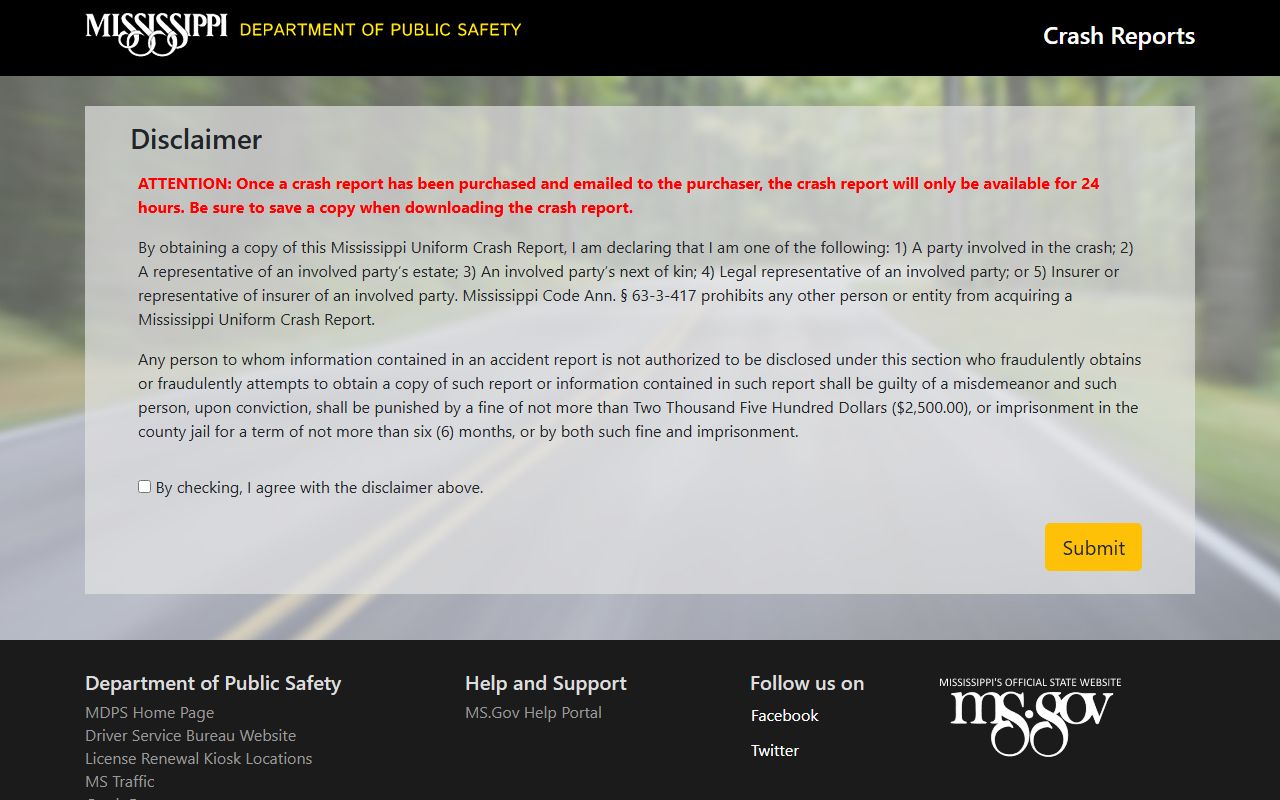
Using the right portal saves money. The online order adds a handling fee, while an in-person request at the counter costs less, so the channel you pick depends on whether speed or price matters more.
Background Check Considerations
A casual charge lookup and a formal background check are not the same thing. Reading a public court record to satisfy your own curiosity is fine. Using that information to decide on a job, a lease, credit, or insurance is governed by the federal Fair Credit Reporting Act, and that law sets rules a casual search does not meet. A compliant background check runs through a regulated consumer reporting agency that follows the FCRA, verifies its data, and handles disputes.
The split matters because arrest and charge records can be incomplete or out of date. A charge that was later dismissed may still appear in a raw record. Acting on that without the disposition can lead to a wrong and unfair decision, which is exactly what the FCRA rules are built to prevent.
Important: This site is a private resource and is not a consumer reporting agency under the FCRA, so its information may not be used for employment, credit, tenant, or insurance decisions.
Restricted Charge Records in Tishomingo County
Not every charge record is open. Mississippi shields several categories from ordinary public view. Youth court records involving children are generally confidential and are released only to a narrow set of people, such as the child, a parent or guardian, an attorney, an agency, or someone with a court order. A sealed or expunged charge should not be treated as visible at all once the order takes effect. Records that hold personal identifiers, like Social Security numbers, financial account numbers, medical detail, or the names of minors, are redacted or withheld even when the rest of the file is public.
Open investigations are another limit. While a matter is still being worked, the underlying records may be held back, and a sworn affidavit that has not led to an arrest may not appear in any public index. The Mississippi Public Records Act, Miss. Code Section 25-61-1, favors access, but it bows to these confidentiality rules. You can read the act through the Mississippi Ethics Commission at its Public Records Act page.
For the rest of a case, the charges are only the opening. Pleas, hearings, the verdict or plea, and the sentence all live in the full file. Those details, and how to read a disposition, sit on the Tishomingo County criminal court records page, which picks up where the charge record leaves off.